

✨ Area 51 in Movies & Books
Out in the Nevada desert, behind razor wire and motion sensors, a silent airstrip cuts through the dust. No road signs. No welcome gate. Just unmarked planes, black convoys, and a curtain of secrecy that has held for decades.
Most Americans will never see Area 51 with their own eyes. Yet almost everyone has seen it on a screen.
Most people will never get within ten miles of Area 51. The government makes sure of that. But somehow, Hollywood got there first and millions of Americans have been watching ever since. This is every major film, show, and book that took America’s most secretive base and turned it into a story.
Hollywood has turned this hidden test range into an icon of mystery. From bombastic alien invasions to slow-burn thrillers about secret military bases, Area 51 movies and novels have done something extraordinary. They turned a once unknown facility into the beating heart of the modern UFO mythos.
But here is the catch. Some of the details that seemed like wild fiction in the 1990s quietly turned up later in declassified documents. Real spy planes. Real black projects. Real test flights over Nevada at hours when the rest of the country was asleep.
So how much did the movies guess right? And how much did authors know before the rest of us did?
🔥✅ Key Takeaways
- Area 51 movies and TV shows transformed a secret Nevada test site into a global symbol of UFOs and government conspiracies.
- Many popular storylines mirror real declassified projects like the U-2 and A-12 Oxcart, which once triggered widespread UFO sightings.
- Films and series often use recurring archetypes—whistleblowers, hidden scientists, and black-ops officers—based on real intelligence structures.
- Books such as the Bob Mayer Area 51 series blend verified facts with speculation to create deeply convincing fictional universes.
- Declassified documents show Area 51 is both less fantastical and more technologically advanced than Hollywood portrays.
Table of Contents
✍ Quick Reference Table: Area 51 Movies
| Type | Title | Year | Focus |
|---|---|---|---|
| Movie | Independence Day | 1996 | Alien craft hidden at Area 51, secret government pact |
| Movie | Showdown at Area 51 | 2011 | Alien confrontation inside a classified facility |
| Movie | Area 51 | 2015 | Found footage infiltration of the base |
| Series | Stargate SG‑1 & Continuum | 1997+ | Secret program partly tied to military black sites |
| Book Series | Bob Mayer Area 51 series | Late 1990s+ | Ancient aliens, hidden tech, global conspiracies |
Quick Answer: Area 51 has become a central stage for American science fiction and conspiracy storytelling, especially in film, television, and novels. From blockbusters like Independence Day to lower budget thrillers such as Showdown at Area 51 and book sagas like the Bob Mayer Area 51 series, these stories blend real declassified details about the Nevada test site with speculation about UFOs, alien technology, and government cover ups.
🎬 Movies

🚀 The Big Turning Point: Independence Day & The 1990s UFO Wave
For many viewers, Area 51 first truly came alive in 1996.
In Independence Day, the President is flown to a nameless desert base. Hangar doors roll back. Inside, beneath harsh white lights, sits a crashed alien craft. Scientists in lab coats. Secret generals. The revelation that a select few in the government knew about the threat all along.
That imagery hit at a very specific moment in U.S. history. In 1995 and 1996, public interest in UFOs surged as the Air Force released newer explanations for the Roswell incident. At the same time, early Internet forums amplified talk of secret military bases and groom lake rumors.
Independence Day did more than entertain. It codified the idea that Area 51 was not just a test site, but the vault for alien wreckage and reverse engineered tech.
👁️🗨️ Area 51 as a Horror Setting: Found Footage & Claustrophobia
As the 2000s wore on, filmmakers shifted from epic space battles to more personal, grounded terror.
The 2015 film Area 51, produced by Oren Peli of Paranormal Activity fame, tried a different tactic. Instead of war rooms and presidents, we get young thrill seekers breaking into the Nevada facility with consumer cameras and improvised gear.
The film takes its time depicting:
- Unmarked warning signs on empty highways
- Remote sensors hidden in the dust
- Patrol trucks sweeping the perimeter
While the aliens are fictional, the security vibe is not. Reporters and researchers who have approached the Area 51 perimeter describe similar signs, pickup trucks on ridge lines, and the feeling of being watched long before they see a guard.
By dropping viewers inside the fences, the film taps into a very real American fear. What happens inside places we are told never to approach.
⚔️ Showdown at Area 51 & The Conflict Narrative
Showdown at Area 51, a 2011 sci fi movie, leans into direct confrontation. The plot pits humans and rival aliens against each other inside a secret installation that clearly echoes Area 51.
While the movie is firmly in the B‑movie category, it reflects a pattern in how fiction portrays the base. There is usually:
- A hardened military officer who knows more than they say
- A civilian or outsider who accidentally learns too much
- An internal threat that the facility barely contains
This setup mirrors the anxiety many Americans feel about classified programs. The sense that powerful projects are running out of sight, and that a single breach could have global consequences.
Even the Area 51 cast in such movies often tracks these archetypes. Eventually, audiences recognize them on sight. The whistleblower. The skeptic. The shadowy handler who walks too confidently in the dark.
📺 Series
🧩 Television & The Slow Burn Mystery of Secret Programs
Movies hit like a shockwave. TV series do something else. They slowly, patiently, build a mythology.
Shows like Stargate SG‑1 and other long form sci fi projects rarely name Area 51 in every episode. But they live in the same atmosphere of hidden bases, classified gateways, and compartmentalized information.
American viewers grew used to the idea that behind the official Pentagon headlines, there were bunkers, labs, and airstrips where reality bent.
Some series have directly shown Area 51 as a location for alien tech storage, advanced aircraft construction, or even prison facilities for extraterrestrials. Others used generic desert compounds that were clearly meant to evoke it without naming it.
📡 Streaming Era: Docu-Dramas & Semi Real Exposes
When streaming platforms exploded, so did docu drama hybrids. Several reality style shows and mini series tackled Area 51 from an investigative angle. They mixed:
- Dramatic reenactments of alleged security breaches
- Interviews with former military personnel and alleged insiders
- Recreated flight paths and radar data
These series blurred the line between entertainment and investigation. While not strictly scripted science fiction, they helped normalize Area 51 as a key character in the modern American conspiracy landscape.
Even when they used actors to portray guards, scientists, or UFO witnesses, they mined from real case files, open source satellite images, and declassified Air Force reports.
📚 Book Series
🧠 The Bob Mayer Area 51 Series: Fiction Built on Fragments of Truth
If films provide the flash, novels provide the depth.
Among the most talked about literary treatments of the base is the Bob Mayer Area 51 series. Beginning in the late 1990s, Mayer crafted a sprawling narrative that ties the Nevada facility to:
- Ancient alien civilizations
- Hidden technological caches around the world
- Shadowy organizations embedded within governments
Mayer, a former Green Beret, wrote with a particular awareness of how the military compartmentalizes secrets. His series imagines Area 51 not just as a warehouse for UFO debris, but as the nerve center in a global, centuries long plan.
Readers noticed something interesting. The chronology of his fictional secret projects often paralleled real world revelations about black programs. While not proof of special access, it showed how a careful observer could weave public leaks, rumor, and history into a deeply convincing conspiracy narrative.
🧪 The Area 51 Incident & Other Novelized Operations
Books bearing titles like The Area 51 Incident tap into a more surgical idea. Less global saga, more one catastrophic event inside a locked facility.
The Area 51 Incident plot pattern usually goes something like this:
- A classified experiment or alien specimen is stored in the base.
- Something goes wrong. Containment fails or a system is sabotaged.
- A small group of insiders must survive, escape, or stop the spread.
- The government moves to erase all traces, rewriting the official story.
While fictional, this structure speaks directly to public suspicion about how the U.S. government might handle an unexplainable breakthrough or disaster. Seal it off. Deny. Reclassify. Then bury what happened inside a maze of security clearances.
📖 From Mass Market Paperbacks to Cult Classics
Area 51 centered novels now occupy their own niche in American paperback history. Airport racks have carried them. Military thriller shelves hosted them next to espionage tales.
Over time, a pattern emerged:
- Early books focused on aliens and reverse engineering.
- Later works blended cyber warfare, AI, and secret space programs.
- Recent titles fold in real world topics like drone warfare and surveillance.
This evolution mirrors what we know from declassified records. The base that once tested U‑2 spy planes now likely supports far more advanced systems. As the technology moves forward, so do the stories built around it.
🌍 Pop Culture Impact
🎥 How Movies Shaped What We Think Area 51 Looks Like?
Ask most Americans to picture Area 51, and they will describe something that looks suspiciously like a movie set.
Films often exaggerate how isolated the base is, but in reality many people are surprised to learn how far Area 51 is from Las Vegas and how accessible its surrounding highways actually are.
Gigantic hangars. Massive underground doors. Bright sterile labs with glass walls. Alien corpses lying under white sheets.
Yet declassified CIA documents about the Nevada Test and Training Range paint a more functional picture. Runways. Storage. Radar test ranges. Housing for workers flown in on unmarked planes, sometimes called the Janet flights.
Media historians note that Hollywood heavily influenced how Americans visualize Area 51, blending real secrecy with fictional elements.
Hollywood did not just mirror reality. It manufactured a new shared mental image. Now, if reality contradicts the cinematic version, people often suspect the official line more than the movies.
😂 Memes, Protests & The Storm Area 51 Moment
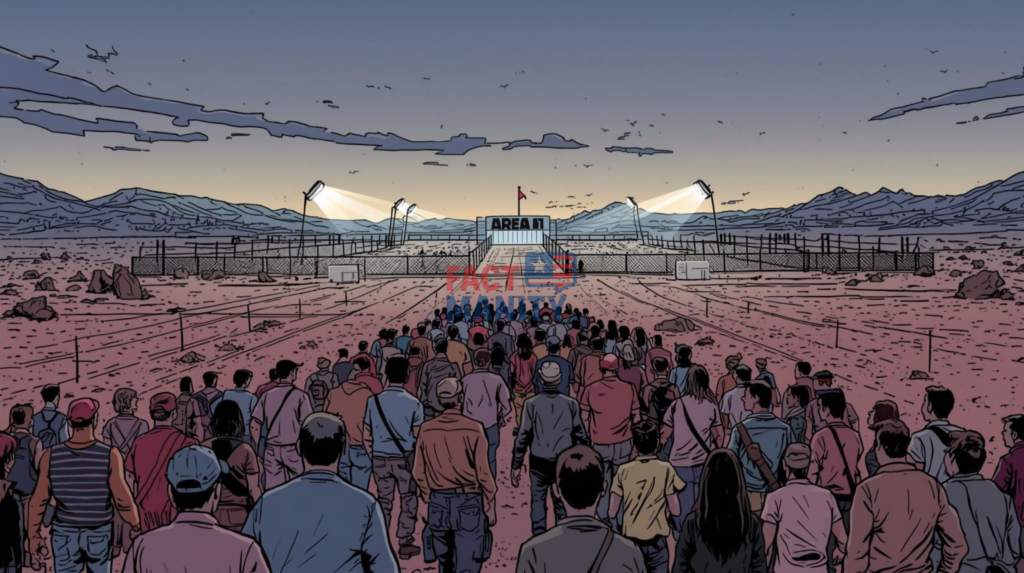
In 2019, a joke Facebook event called “Storm Area 51, They Cant Stop All of Us” went viral. What started as a meme turned into a cultural moment.
People shared training videos of how to run like anime characters across the desert. But underneath the humor was something serious. A generation had grown up on Area 51 movies, video games, and novels. The base felt less like an unknown installation and more like a mythological fortress that belonged to the public imagination.
The government responded with very real warnings. The Air Force emphasized that the facility was an active training range, off limits and fully defended. When the September date arrived, only a small number of people showed up in Nevada. There was no mass breach. Yet the episode proved how deeply the base had sunk into pop culture.
Area 51 is not the only U.S. site wrapped in symbolism and speculation—public spaces like airports have also fueled mystery, as seen in the Denver Airport murals conspiracy that continues to attract global attention.
🔓 From Fringe Conspiracy to Mainstream Curiosity
Forty years ago, talking openly about Area 51 could get you labeled a crank. Today, mainstream outlets casually mention it in news segments about UAP hearings and Pentagon UFO task forces.
Movies and books softened the ground. They taught millions how to pronounce “Groom Lake,” and made it normal to ask what might be flying over Nevada at 2 a.m.
Long before Area 51 entered the mainstream, real government programs quietly experimented with secrecy and control—projects like Operation Midnight Climax later revealed how far authorities were willing to go in the name of national security.
By the time the CIA officially acknowledged the existence of the facility in 2013, the public reaction was almost a shrug. Fiction had already done the heavy lifting. Most people felt like they knew the place, even if they had only seen it through a lens of special effects and suspenseful plotting.
🏛️ Government Involvement & Evidence

📜 Declassified History of a Secret Base
Behind every wild story is some bare metal truth.
Declassified documents obtained through the Freedom of Information Act show that Area 51 was crucial in testing the U‑2 reconnaissance aircraft in the 1950s, then the A‑12 Oxcart, a predecessor to the SR‑71. These aircraft flew higher than any commercial plane. Civilian pilots looking up often had no framework to explain what they saw.
Many UFO reports in the late 1950s and early 1960s line up with high altitude test flights. The CIA quietly tracked these reports, not because they believed in aliens, but because they needed to know how visible their secret projects were.
🧾 Leaked Documents & Evidence
Over the years, a mosaic of evidence has surfaced:
- Declassified CIA histories confirming the site as a test hub for U‑2 and Oxcart.
- Satellite imagery revealing new hangars and extended runways appearing over time.
- Firsthand testimonies from former workers describing intense secrecy, security checks, and specialized transport flights.
None of these prove alien craft are parked in Hangar 18. They do, however, confirm that the base is used for extremely sensitive technology, often decades ahead of what the public sees.
Historical records show that high-altitude U-2 and A-12 Oxcart flights were responsible for many early UFO sightings reported over Nevada.
This is the narrow bridge where evidence meets speculation. If the U‑2 looked like a UFO in 1955, what might look like one today.
⚖️ Theories VS Facts

✅ Fact: Area 51 Is Real & Deeply Classified
Fact number one is simple. Area 51 exists. It sits inside the Nevada Test and Training Range. It has runways, hangars, radar facilities, housing, and perimeter security that is visibly active even from legal distances.
Multiple U.S. government agencies have acknowledged using it for aircraft testing and classified training. This is documented and corroborated by declassified files and satellite imagery.
👽 Theory: Alien Craft & Bodies Stored Inside
The most famous theory says that after crashes like Roswell, the U.S. government transported alien wreckage, and possibly bodies, to Area 51.
Movies such as Independence Day and novels like those in the Bob Mayer Area 51 series treat this as foundational truth in their universes. It makes for compelling storytelling.
Evidence for this claim, however, is mostly anecdotal. Eyewitness accounts, secondhand stories, and alleged insiders who cannot be independently verified. The Air Force has repeatedly insisted that no such materials are stored there.
Some theories go even deeper, pointing to alleged internal programs like Project Abigail at Area 51, which blends rumored experiments with fragments of documented secrecy.
For now, this remains a theory built on patterns and rumors, not hard documents.
⚙️ Middle Ground: Black Projects That Look Like Science Fiction
Between pure fact and pure legend sits a strange territory.
We know that at various times, the U.S. has tested aircraft and drones that looked futuristic even to experienced pilots. Stealth shapes. Exotic materials. Unusual flight profiles.
Some UFO reports that inspired Area 51 movies and the Area 51 Incident plot style narratives may be rooted in these black projects. Not alien, but advanced enough to spark awe, confusion, and secrecy.
It is very possible that reality at Area 51 is a blend. No little gray bodies on slabs. But also not ordinary at all.
👉 Read more about Pentagon UFO reports
🧵 Micro Stories: When Fiction Echoes Reality
Story 1: The Janitor Who Came Home Quiet
A man in Nevada told his family he worked “out at the site” but never said more. Every Monday, a bus picked him up pre dawn. Every Friday, it dropped him off at dusk. Years later, his daughter saw Independence Day and froze at the Area 51 scenes. “Dad,” she said, “is that where you worked.” He smiled, shook his head, and changed the subject. He passed away without leaving a single photo of his workplace.
Story 2: The Amateur Astronomer
In the 1990s, an amateur sky watcher kept a log of strange lights over Nevada. Objects moved too fast, too high, then vanished. A decade later, the Air Force declassified certain unmanned systems tested in the same time window. The shapes in glossy concept art eerily matched what he had scribbled in his notebook under the word “Unknown.”
Story 3: The Screenwriter with a Security Clearance
One Hollywood writer consulted a former contractor who had worked near Groom Lake. The contractor refused to discuss aliens. Instead, he spoke about endless background checks, polygraphs, and instructions never to talk about flight schedules.
The writer walked away with no juicy UFO secrets, but a vivid feel for the pressure cooker environment. Months later, he poured that tension into a film script about a base where secrecy itself becomes the monster.
Story 4: The Tourist Turned Back
A couple on a road trip near Nevada followed a dirt road out of curiosity. No signs at first, just empty desert. After several miles, they saw a sudden forest of warnings. Armed patrols. Photography forbidden.
They hesitated, took a quick photo anyway, and turned around. Less than five minutes later, a white truck appeared in their rearview mirror and followed them back toward the highway. They never saw the driver, but they deleted the photos that night.
Story 5: The Reader Who Thought It Was All Fiction
A college student devoured the Bob Mayer Area 51 series, assuming every detail was invented. Years later, in a defense policy course, he studied real world programs and discovered that some background elements in Mayer’s books mirrored known practices in black projects.
Not proof of any hidden knowledge. But enough to make him wonder how thin the line between educated guess and reality can be.
📌 Quick Facts
- Area 51 sits within the Nevada Test and Training Range, northwest of Las Vegas.
- The base was a key site for U‑2 and A‑12 Oxcart spy plane development.
- Area 51 was officially acknowledged by the CIA in declassified documents released in 2013.
- Hollywood popularized Area 51 as a vault for alien technology and UFOs.
- The Area 51 cast in many films echoes recurring archetypes like whistleblowers and shadowy officials.
- The Bob Mayer Area 51 series is one of the most extensive book sagas built around the base.
- Many UFO reports near Nevada coincide with known test periods for advanced aircraft.
💭 Final Thoughts & Next Steps!
Area 51 lives in two worlds. In one, documented by declassified files, it is a harsh, sun baked test site where engineers and pilots push the edge of aeronautical technology. In the other, shaped by films, shows, and novels, it is a subterranean vault for alien craft, ancient secrets, and world altering discoveries.
Most of us will never cross its perimeter. But we cross into its storylines every time we watch an Area 51 movie, stream a docu drama about UFOs over Nevada, or sink into a late night reading session of the Bob Mayer Area 51 series.
If classified programs and hidden history fascinate you, explore more deep investigations across FactManity.
If this hidden base fascinates you, explore our related deep dives on secret military programs, declassified projects, and the history of American UFO investigations. Each file opened, each timeline reconstructed, pulls one more thread from the fabric of mystery wrapped around that lonely desert runway.
Curious how many other American secrets were shaped by movies before the truth came out?
Explore our growing collection of conspiracy deep dives, declassified programs, and hidden U.S. history stories — where fiction ends and reality quietly begins.
Disclaimer: This article is for informational and entertainment purposes only. It explores the portrayal of Area 51 movies, television, books, and popular culture alongside publicly available historical and declassified information. It does not claim the existence of extraterrestrial technology or classified materials beyond officially acknowledged sources. Interpretations, theories, and narratives discussed here should not be considered factual proof or legal, scientific, or governmental confirmation.
FAQs ❓
What is the most influential Area 51 movie?
Independence Day is widely considered the most influential Area 51 themed film. It imprinted the idea that the base stores crashed alien craft and set the visual template that many later movies and series echoed.
Is Showdown at Area 51 based on true events?
No. Showdown at Area 51 is a work of fiction. However, it incorporates elements that mirror real security concerns at secret facilities, such as compartmentalized access, hidden labs, and internal conflicts.
Are any Area 51 casts based on real people?
Most Area 51 cast members in film and TV are fictional characters. That said, archetypes like the tight lipped colonel, the conflicted scientist, and the guilt ridden whistleblower often draw inspiration from real patterns seen in military and intelligence whistleblower cases.
What is the Bob Mayer Area 51 series about?
The Bob Mayer Area 51 series is a set of interconnected novels that blend ancient aliens, secret history, and modern black projects. The stories center on Area 51 as a hub in a much older and broader extraterrestrial storyline.
How accurate are movies about the Area 51 Incident plot?
Stories built around an Area 51 Incident plot borrow loosely from how the government might respond to a serious containment breach or classified accident. Procedural elements like lockdowns and rapid response teams are somewhat realistic, but specific alien related events are fictional.
Has the U.S. government admitted to any UFOs at Area 51?
No official admission has stated that alien craft or bodies are stored at Area 51. Government disclosures have focused on advanced but human built aircraft testing, though they acknowledge that such flights contributed to UFO sightings in the past.
Why does Area 51 keep appearing in pop culture?
Area 51 sits at the crossroads of secrecy, cutting edge technology, and the possibility of nonhuman intelligence. That combination makes it an irresistible setting for writers and directors who want a ready made stage for mystery, tension, and world altering revelations.