

Introduction
Florida is famous for sunshine, beaches, and headlines that make the rest of America pause and ask, “Wait… what?” But beyond the viral news stories lies something even stranger… Florida’s law books.
What makes Florida different from every other state on this list is that Florida doesn’t need exaggeration. The real laws are strange enough. We checked every one of these against Florida’s official state statutes and the ones that didn’t hold up, we cut. What’s left is the real list.
Table of Contents
🔥 Key Takeaways
- ✅ Florida has a mix of genuinely enforced unusual laws and long-lived urban legends.
- ✅ Many “weird laws in Florida” are actually old local ordinances or misquoted stories… proceed with healthy skepticism.
- 🔥 Feeding wildlife (especially alligators) and interfering with traffic signs are real problems with real fines.
- ✅ Knowing the difference between myth and statute can save you embarrassment and possibly a ticket.
- 🔥 This guide mixes facts, examples, and the occasional WTF moment… so you can laugh responsibly.
👉Reference Table: Weird Laws in Florida
| # | The Law | Where | Still Active? | Enforce Risk |
|---|---|---|---|---|
| 1 | Feeding alligators is illegal | Statewide | ✅ FL Statute 372.667 | 🔴 Real — Fined |
| 2 | Releasing more than 9 balloons = crime | Statewide | ✅ FL Statute 372.992 | 🔴 Real — $250 Fine |
| 3 | Unmarried couples living together was illegal | Statewide | ❌ Repealed 2016 | 🟢 Historical |
| 4 | Singing in public in a swimsuit is banned | Sarasota | ✅ Local Ordinance | 🟡 Rare |
| 5 | Indoor furniture banned outdoors | Cape Coral | ✅ City Code | 🔴 Enforced |
| 6 | Must pay broken parking meters | Tampa, Miami | ✅ Municipal Code | 🔴 Real |
| 7 | Street orange selling requires permit | Statewide | ✅ FL Agriculture Law | 🟡 Rare |
| 8 | Tying elephant to parking meter = paid parking | Multiple cities | ✅ Municipal Codes | 🟢 Low |
Quick Answer: Yes, Florida has a weird legal wardrobe… some rules are archaic relics, others are modern and actually enforced. If you’re wondering about a specific “weird law in Florida,” check if it is a state statute, a county ordinance, or just a viral myth.
8 Weird Laws in Florida 🤯
Florida does not need help being weird. Any state that produces a genuine news genre, “Florida Man” has already crossed a threshold that most states never approach.
But beyond the headlines, Florida’s legal code has its own quiet strangeness. Some of these laws are actively enforced right now. Some were real for decades before anyone bothered to remove them. And some exist because Florida, at various points in its history, clearly had very specific problems that needed very specific solutions.
Every law here is verified. Every source is real. Let’s get into it.
🐊 Law #1: Feeding an Alligator in Florida is a Crime
Source: Florida Statute 372.667
This is not a quirky old rule that nobody enforces. Florida Fish and Wildlife Conservation Commission officers actively cite people for feeding wild alligators… and they do it regularly.
The statute makes it a second-degree misdemeanor to intentionally feed a wild alligator. The penalty includes fines and potential jail time. First offense fines typically run between $250 and $500. Repeat offenders face higher penalties.
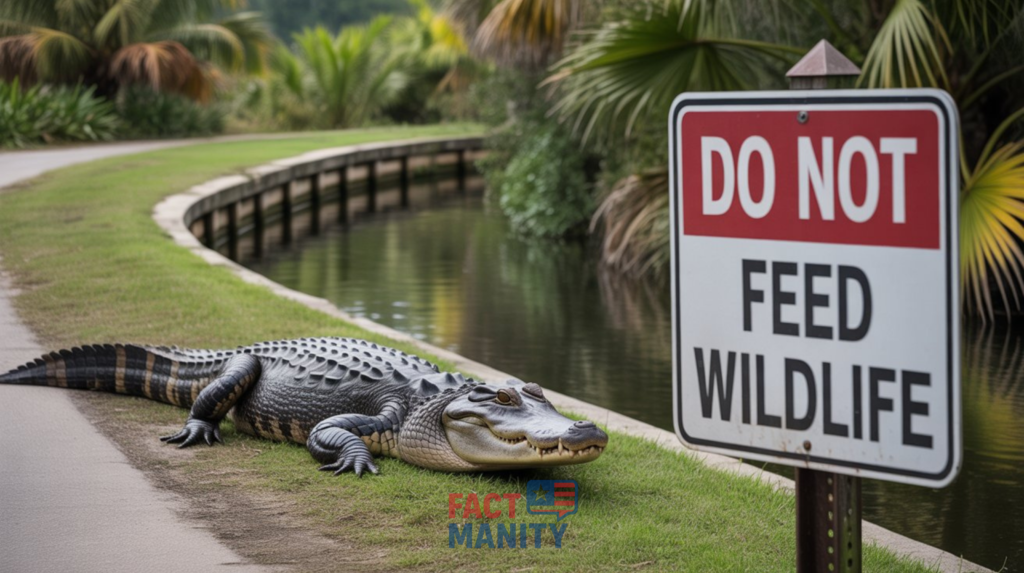
The reason the law exists is not abstract. Florida has approximately 1.3 million alligators. They live in every county in the state, in lakes, rivers, ponds, golf course water hazards, and occasionally in suburban backyards. An alligator that associates humans with food loses its natural wariness of people. That animal becomes genuinely dangerous, not because alligators are inherently aggressive, but because a food-conditioned alligator will approach humans expecting to be fed.
Every year, Florida wildlife officers must euthanize alligators that have been fed by residents or tourists. The law is designed to prevent that outcome by making the feeding itself the violation before anyone gets hurt.
👉 If you see an alligator in Florida: Do not feed it. Do not approach it. Call 1-866-FWC-GATOR. This is not a joke.
🎈 Law #2: Releasing More Than 9 Balloons at Once is Illegal
Source: University of Florida
Florida’s Balloon Release Prohibition Act makes it illegal to intentionally release nine or more balloons filled with lighter-than-air gas within a 24-hour period. The fine is $250 per violation. To release ten or more balloons, a special permit from the circuit court is required.
The law was enacted in 1990, and it was not written on a whim. Mass balloon releases were a common feature of Florida outdoor events, stadium celebrations, and public gatherings. Balloons released into the atmosphere eventually come down in the ocean, in wetlands, in waterways. They are ingested by sea turtles, dolphins, manatees, and seabirds who mistake deflated balloon material for jellyfish or other food.
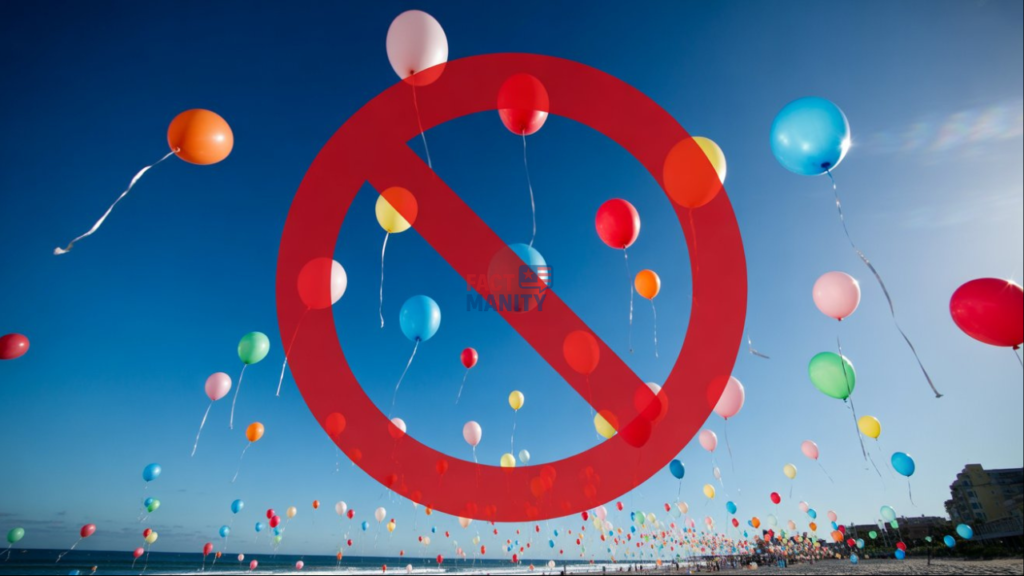
Florida has some of the highest concentrations of protected marine species in the continental United States. The Balloon Release Prohibition Act was a direct response to documented harm to those animals.
The nine-balloon limit is not arbitrary, it reflects the threshold at which releases begin to constitute meaningful environmental impact under the law’s framework.
✔ Reality check: This law is enforced. Florida environmental officers have issued citations under it. If you are planning an outdoor event in Florida that involves balloon releases, count carefully.
💑 Law #3: Unmarried Couples Living Together Was Technically Illegal Until 2016
Source: Florida Statute 798.02 — Repealed 2016
From the time Florida was admitted to the Union until March 2016, it was technically a second-degree misdemeanor for an unmarried man and woman to live together in Florida.
The statute, Section 798.02 of the Florida Statutes, classified cohabitation as “lewd and lascivious behavior”, the same legal category as other public decency offenses. The maximum penalty was 60 days in jail and a $500 fine.
The law was almost never enforced by the 21st century. But “almost never enforced” is different from “not a law.” Up until Governor Rick Scott signed the repeal in March 2016, millions of unmarried Florida couples were technically committing a misdemeanor by sharing an address.
A Republican state lawmaker named Ritch Workman sponsored the repeal after realizing the law was still on the books. He described it as “an ancient relic” during the legislative debate. The repeal passed with broad bipartisan support.
🛑 Why it matters: This law is a useful reminder that “nobody enforces it” is not the same as “it doesn’t exist.” Florida had an anti-cohabitation law on its books within living memory and it took a specific legislative effort to remove it.
🎤 Law #4: Singing in a Swimsuit is Illegal in Sarasota
Source: Sarasota, Florida Local Ordinance
Sarasota has a city ordinance that prohibits singing in public while wearing a swimsuit.
The ordinance dates to the early 20th century, the period when American beach culture was expanding rapidly and city governments across Florida were trying to navigate the tension between tourism, public decency, and what was considered appropriate behavior in shared public spaces.
The specific combination of singing and swimwear was apparently enough of a recurring issue in Sarasota that lawmakers decided to address it with a dedicated rule. The ordinance was likely intended to prevent loud, attention-seeking behavior in public areas while simultaneously touching on dress code standards.
Today the ordinance still exists in Sarasota’s municipal code never challenged, never repealed. The likelihood of enforcement in 2026 is minimal. But if you are in Sarasota, in a swimsuit, and you feel a song coming on technically, you should step inside first.
🛋️ Law #5: You Cannot Put Indoor Furniture Outside in Cape Coral
Source: Cape Coral City Code
Cape Coral, Florida has a city ordinance that prohibits placing indoor furniture, sofas, recliners, mattresses, or similar items in outdoor spaces like driveways, carports, or front yards.
Unlike many laws on this list, this one is actively enforced. Cape Coral’s code enforcement officers issue citations for outdoor furniture violations regularly. The fine is real.
The origin of the law is neighborhood standards. Florida’s rapid suburban growth in the mid-to-late 20th century brought thousands of new residential developments with homeowner association-style expectations around property appearance, even in areas without formal HOA oversight. Cape Coral, one of the fastest-growing cities in the United States, needed a mechanism to prevent properties from looking abandoned or neglected.
A couch on a driveway became the legal line. Cross it and you get cited.
✨ Practical note: This specific ordinance applies in Cape Coral. Similar rules exist in various forms in other Florida municipalities. If you live in Florida and you are planning to leave a sofa outside for any reason… check your city code first.
🅿️ Law #6: You Must Pay Broken Parking Meters in Tampa and Miami
Source: Tampa and Miami Municipal Codes
Both Tampa and Miami have municipal regulations that require drivers to pay for parking even when the meter is broken by finding a working meter nearby or using a mobile payment app if available.
If the meter is broken and no alternative payment exists, drivers can still receive a parking ticket.

The logic behind the rule is straightforward: the city does not want broken meters to function as de facto free parking. The problem this creates for visitors is equally straightforward: you can arrive at a broken meter, have no way to pay, and still receive a fine.
Both cities have app-based payment systems that are supposed to provide an alternative when meters malfunction. In practice, visitors unfamiliar with those systems regularly receive citations they genuinely could not have avoided.
🚕 If you are parking in Tampa or Miami: Download the parking app before you need it. A broken meter is not a free parking space… legally speaking.
🍊 Law #7: Selling Oranges on the Street Without a Permit is Illegal
Source: Florida Department of Agriculture and Consumer Services
Source: Florida Department of Agriculture and Consumer Services
Florida law requires a permit to sell citrus fruit including oranges, in public spaces or along roadsides. Operating without one is a violation of state agricultural regulations.
Florida produces approximately 70% of United States citrus. The state’s agricultural regulations around citrus are extensive covering everything from grove management to pest control to distribution. Roadside sales are regulated specifically because unauthorized vendors can undercut licensed distributors, avoid quality inspections, and misrepresent the origin or variety of fruit.
The law is not primarily designed to stop someone from selling a bag of oranges out of a car trunk but it technically covers that scenario. Florida agricultural inspectors do conduct enforcement actions, primarily targeting large-scale unauthorized operations.
🕺 For tourists: If you see a roadside orange stand in Florida, it is almost certainly licensed. The state has a robust permit system. But the permit is required and the requirement is real.
🐘 Law #8: If You Tie an Elephant to a Parking Meter, You Owe the Meter Fee
Source: Various Florida Municipal Parking Codes
Several Florida cities have parking codes that technically require the parking fee to be paid for any animal tied to a parking meter… including elephants.
This law did not emerge from an imaginary scenario. Florida historically had a significant circus and traveling show industry. Ringling Bros. and Barnum & Bailey Circus had its winter headquarters in Sarasota. Elephants moved through Florida cities regularly as part of touring productions. The question of where to secure an elephant during a stop and whether that location required a fee was a practical one.
Florida’s parking codes did not exclude animals from meter requirements. An elephant tied to a meter occupied a space. That space had a fee. The fee applied.
Today the law exists as a record of Florida’s circus heritage and the bureaucratic thoroughness of its parking regulations. The practical likelihood of needing to apply it is, at this point, extremely low.
Want to see how Florida compares with other states? Check out our deep dive into weird laws in California and see how bizarre rules stack up across the U.S.
Quick Facts ⚡
📌 Quick Facts — Weird Laws in Florida
- ✦Feeding wild alligators is a second-degree misdemeanor — actively enforced statewide
- ✦Florida’s balloon law was passed in 1990 specifically to protect marine wildlife
- ✦Unmarried couples living together was illegal in Florida until March 2016
- ✦Cape Coral actively enforces its outdoor furniture ordinance with real fines
- ✦Florida’s full statutes are searchable at leg.state.fl.us
Final Thoughts 🧠
Florida’s legal landscape is part history book, part sitcom, part public safety manual. If you love lists titled “10 Weird Laws in Florida,” enjoy the schadenfreude, but keep one hand on a reliable legal source. Many weird rules are either local oddities or outright myths, some are legitimately enforced and can get you a ticket or worse.
If you enjoy uncovering strange state laws, don’t miss our breakdown of weird laws in Connecticut, where old statutes and modern rules collide.
In short: don’t feed the wild animals, don’t steal the signs, and maybe keep your swimsuit out of fine dining establishments. And if you see a statute that reads like a late night sketch, assume it’s either a relic or it has a reason tied to safety… even if that reason pops a vein of WTF into your day.
Think Florida’s laws are wild? Share this with a friend who believes every “Florida Man” headline and explore more unbelievable U.S. laws right here.
Disclaimer: This article is for informational and entertainment purposes only and does not constitute legal advice. Laws and ordinances can change over time and may vary by city or county. Always consult official state statutes, local municipal codes, or a qualified attorney for the most accurate and up-to-date legal guidance.
FAQs
-
What is the most enforced weird law in Florida?
The alligator feeding ban under Florida Statute 372.667 is consistently enforced, Florida Fish and Wildlife Conservation Commission officers issue citations regularly, particularly in tourist areas near natural water bodies. The balloon release law (FL Statute 372.992) is also actively enforced at outdoor events.
-
Are funny Florida laws real or just internet myths?
Many funny Florida laws shared online are exaggerated or completely false. Always check whether a rule is a state statute, a local ordinance, or just a viral myth.
-
Do Florida weird laws apply statewide or only locally?
Most strange Florida laws come from local city or county ordinances, not statewide law. A rule in one town may not apply just a few miles away.
-
Can tourists get fined under weird Florida laws?
Yes. Tourists can be fined or cited if they violate enforced laws, especially wildlife regulations, beach rules, or public safety ordinances… even if they sound strange.
-
Why does Florida have so many bizarre laws?
Florida’s weird laws often come from old ordinances, rapid population growth, tourism related issues, and reactions to very specific past incidents.
-
Are weird laws in Florida different from other US states?
Florida stands out due to its wildlife laws, beach regulations, and tourism driven ordinances, but every US state has strange laws rooted in history and local culture.
-
Where can I verify Florida’s laws myself?
Florida’s complete statute database is publicly searchable at leg.state.fl.us. For city-specific ordinances like Sarasota’s singing ban or Cape Coral’s outdoor furniture rule, search your specific city at municode.com.